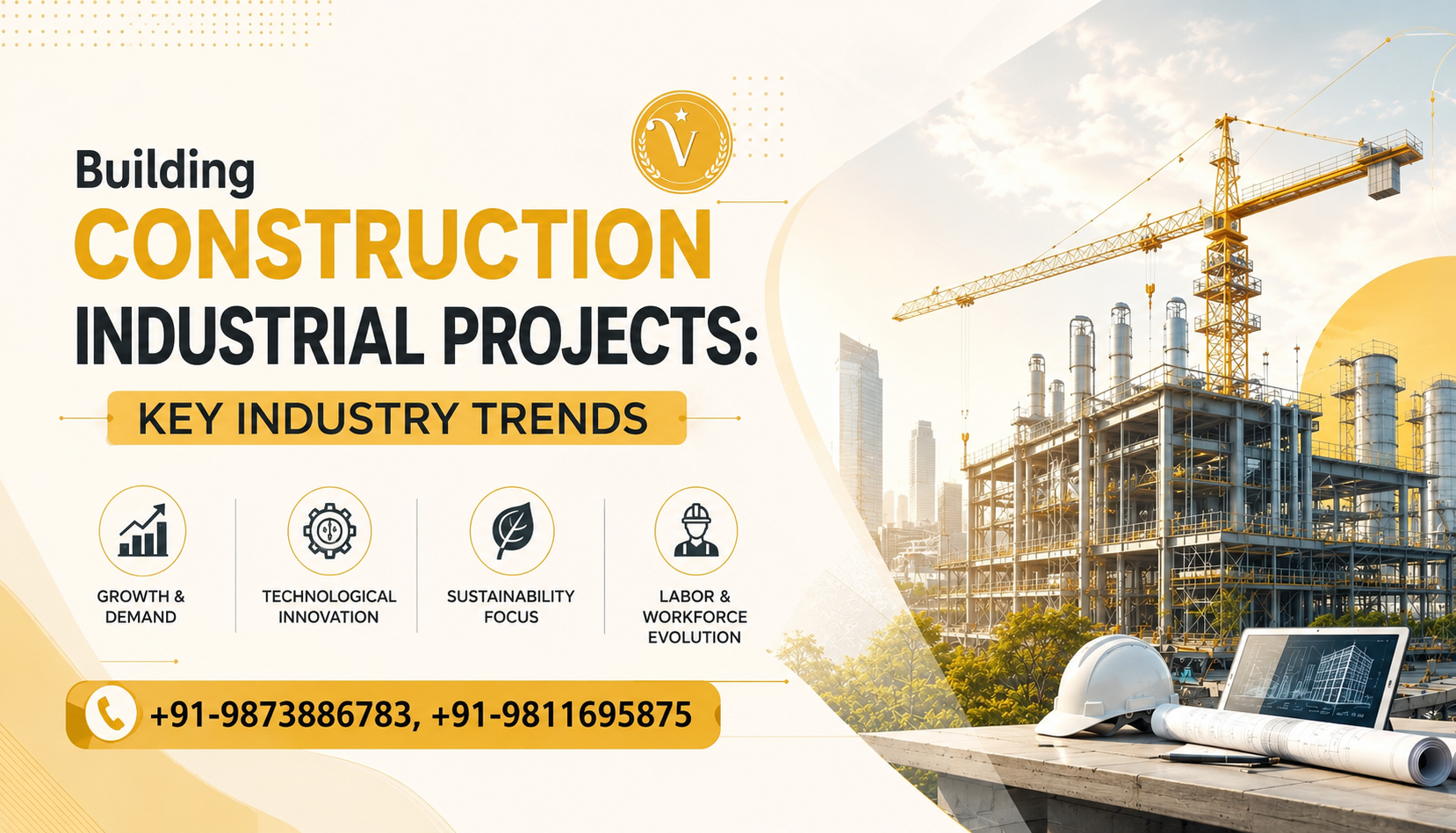
Building Construction Industrial Industry in India is rapidly evolving in 2026, is driven by smart infrastructure demand, digital technologies, and sustainable development practices. India’s construction sector is valued at nearly USD 680+ billion and is projected to grow to over USD 1.2 billion in the coming years showing strong long-term expansion.
Modern construction is no longer limited to traditional methods; it now includes BIM-based planning, AI tools, and prefabricated systems that can reduce project time by up to 30–40% and improve efficiency and quality.
India’s construction sector is also witnessing strong long-term growth of around 7–8% annually in infrastructure-driven segments, supported by industrial corridors, logistics expansion, and smart city development.
At Vinod Builder, we observe a clear shift toward faster, technology-driven project delivery across industrial and manufacturing projects, supported by BIM-based design and modular construction methods.
Let’s read this post to explore the key trends shaping the future of building construction.
Building Construction Industrial: 2026 Transformation Overview
The evolution of Building Construction Industrial projects in 2026 is strongly driven by automation, sustainability, and cost efficiency. Industrial facilities are becoming smarter, more connected, and highly optimized for production flow.
Modern projects are using:
- AI-based design planning
- Digital twin simulation
- Modular construction systems
- Real-time monitoring sensors
These advancements are reducing construction delays by up to 20–40%, making industrial development faster and more predictable.
Types of Construction in Industrial Development
Understanding types of construction is essential in identifying industrial structures correctly. Construction is generally categorized into residential, commercial, industrial, and infrastructure.
Within kinds of construction, industrial projects include large-scale production and operational facilities such as:
- Factories
- Warehouses
- Energy plants
- Manufacturing units
These different types of construction often overlap with logistics and commercial infrastructure in modern hybrid developments.
The growing construction manufacturing industry is merging production techniques with construction workflows, improving precision and scalability.
Key Industrial Construction Trends
The future of Building Construction Industrial is shaped by major global trends:
1. Smart Industrial Facilities
Factories are now connected ecosystems where machines, sensors, and software communicate in real time.
2. Modular & Prefabricated Construction
Prefabrication is expected to account for nearly 30% of industrial projects in advanced markets by 2026.
3. Sustainable Construction Materials
Low-carbon concrete, recycled steel, and energy-efficient systems are becoming standard.
4. AI & Automation Integration
Construction planning, safety monitoring, and scheduling are increasingly AI-driven.
At Vinod Builder, these technologies are being integrated into project planning to improve efficiency and reduce downtime.
Types of Industrial Projects
The range of types of construction projects in industrial development is expanding rapidly:
- Manufacturing factories
- Logistics and distribution centers
- Cold storage facilities
- Energy production plants
- Chemical processing units
A modern factory building is no longer just a production unit—it is a fully optimized system designed for efficiency, automation, and safety.
An industrial factory today integrates robotics, automated assembly lines, and digital monitoring systems for higher productivity.
Traditional vs Modern Industrial Construction
|
Feature |
Traditional Construction |
Modern Industrial Construction |
|
Design |
Manual drawings |
BIM & 3D modeling |
|
Timeline |
Long (12–36 months) |
20–40% faster |
|
Materials |
Conventional |
Sustainable & engineered |
|
Technology |
Limited |
AI, IoT, automation |
|
Efficiency |
Moderate |
High-performance systems |
Challenges in Industrial Construction
Even with advancements, Building Construction Industrial projects face key challenges:
- Rising raw material costs
- Skilled labor shortage
- Regulatory compliance complexity
- Supply chain delays
At Vinod Builder, careful planning and modern project management help reduce these risks through better forecasting and resource control.
Future Outlook of Building Construction Industrial Projects
The future of Building Construction Industrial development is highly digital and automated. By 2026:
- Over 60% of industrial projects are expected to use BIM-based planning
- AI-driven project management will become standard practice
- Sustainable and net-zero industrial buildings will increase rapidly
The industry is moving toward a construction manufacturing industry model, where buildings are assembled like engineered products instead of being built traditionally.
Conclusion
The future of Building Construction Industrial projects in 2026 is defined by innovation, automation, and sustainability. With rapid technological adoption and modular construction practices, the industry is moving toward faster, smarter, and more efficient project delivery systems.
Vinod Builder continues to focus on delivering advanced industrial construction solutions that align with modern industry needs and long-term infrastructure growth.
Frequently Asked Questions
It refers to the design and construction of large-scale industrial facilities like factories, warehouses, and production plants.
Industrial construction includes factories, warehouses, power plants, and manufacturing units.
Factories, logistics centers, and production facilities belong to industrial construction.
It is driven by automation, sustainability, modular construction, and AI-based systems.
It supports manufacturing growth, logistics infrastructure, and economic development.